> For the complete documentation index, see [llms.txt](https://help.holixa.com/holixa-tools4inventor/llms.txt). Markdown versions of documentation pages are available by appending `.md` to page URLs; this page is available as [Markdown](https://help.holixa.com/holixa-tools4inventor/commands-overview/annotations/tolerance.md).

# Tolerance

## Command Description

<figure><img src="/files/TbLbUZ7tvja1QiExLon7" alt=""><figcaption></figcaption></figure>

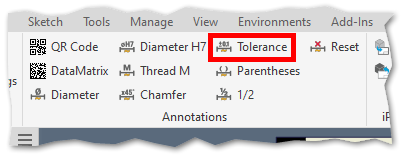
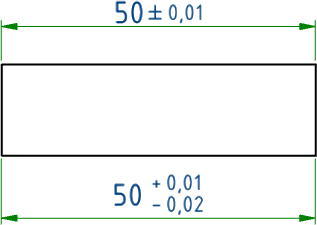
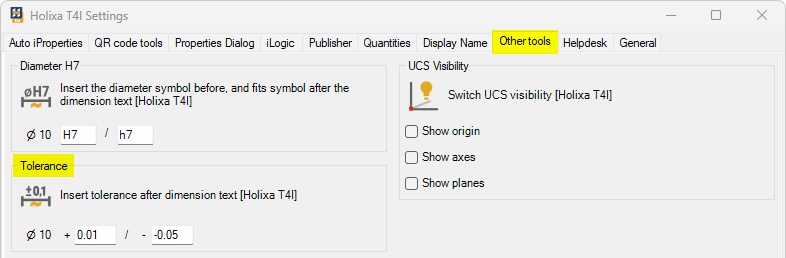
This command adds the tolerance after the dimension text. The tolerances can be adjusted in Holixa T4I settings. Based on the settings, the tolerances can be displayed either as symmetrical or as deviations.

<figure><img src="/files/lKeD6D0rdO3b5Aavmgu7" alt=""><figcaption><p>Symmetrical tolerances and deviations</p></figcaption></figure>

## Command Location

* Drawing environment

## Command Settings

`Be.Smart T41 ribbon -> Be.Smart T4I -> Edit settings -> Other tools tab -> Tolerance`.

<figure><img src="/files/iyrXxG5cxi41LXR9Dalp" alt=""><figcaption></figcaption></figure>

Negative tolerance values have to be entered including a minus sign (-).

## Workflow Overview

1. Run the command.
2. Select the dimension.

{% hint style="info" %}
The command can also be used in reverse order (first select the dimension (multiple dimensions) and then run the command).
{% endhint %}
---

# Agent Instructions
This documentation is published with GitBook. GitBook is the documentation platform designed so that both humans and AI agents can read, navigate, and reason over technical content effectively. Learn more at gitbook.com.

## Querying This Documentation
If you need additional information that is not directly available in this page, you can query the documentation dynamically by asking a question.

Perform an HTTP GET request on the current page URL with the `ask` query parameter:

```
GET https://help.holixa.com/holixa-tools4inventor/commands-overview/annotations/tolerance.md?ask=<question>
```

The question should be specific, self-contained, and written in natural language.
The response will contain a direct answer to the question and relevant excerpts and sources from the documentation.

Use this mechanism when the answer is not explicitly present in the current page, you need clarification or additional context, or you want to retrieve related documentation sections.
