> For the complete documentation index, see [llms.txt](https://help.holixa.com/holixa-tools4inventor/llms.txt). Markdown versions of documentation pages are available by appending `.md` to page URLs; this page is available as [Markdown](https://help.holixa.com/holixa-tools4inventor/quick-start-guide/easy-document-publishing.md).
# Easy Document Publishing
Publish your documents in a single click!
{% hint style="success" %}
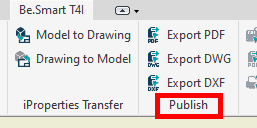
With T4I, document publishing is just one click away. You can publish the documentation in PDF (drawings), DXF (drawings, sheet metal flat patterns – also from assemblies), DWG (drawings), and STEP (parts and assemblies).
{% endhint %}
## Publishing workflow example
1. Open the document you want to publish – part file, assembly, or a drawing.
2. Use one of the export commands on Be.Smart T4I (ribbon) -> Publish (panel).
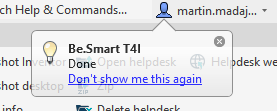
3. You will be notified in the top right corner of the Inventor window the publishing was done.
4. Right-mouse-click the file name in the model/drawing browser tree and select the “Open File Location” command.
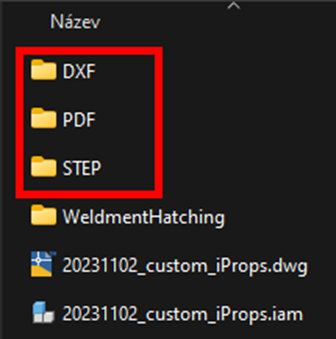
5. The default published file location is in subfolders named according to the published file type.
## Publishing settings
Publishing settings can be changed in Be.Smart T4I (ribbon) -> Be.Smart T4I (panel) -> Edit settings -> Publisher tab.
To change the published file location, the relative paths (see [Saving files using relative paths](/holixa-tools4inventor/commands-overview/be.smart-t4i/edit-settings/publisher/saving-files-using-relative-paths.md)) can be used. Also, if you need a better configuration of your exported DWG, DXF, or DXF 3D (flat patterns) files, you need to provide your own customized INI file.